How to Schedule Deep Work Without Ignoring Your Meetings
Ten meetings a week doesn't have to mean zero deep work. How to find 90-minute windows, stack meetings, and plan a week where both get done — with a worked example.
The Daykite team7 min read
Deep work — the demanding, concentrated work that actually moves projects forward — needs long, uninterrupted stretches. Meetings are the enemy of long stretches. Not because there are too many of them, necessarily, but because they're spread out: a 30-minute call at 10:30 and another at 14:00 turn a whole day into pieces too small for anything serious.
You probably can't cancel all your meetings. You don't need to. You need to arrange them so that deep work fits in between. This guide shows how, with a real week that goes from zero deep-work windows to four.
Why meetings kill deep work
Three things happen when meetings are scattered through a day:
- Fragmentation. A 3-hour morning with one meeting in the middle becomes two 75-minute pieces. Once you subtract the time to start and stop, there's little real focus left.
- Anticipation. Even an hour before a meeting, many people avoid starting anything demanding because they know they'll be interrupted. The meeting costs more than its length.
- Recovery. After an intense meeting, it takes time to refocus. Back-to-back meetings followed by "now do deep work" rarely works.
The solution to all three is the same: fewer, longer gaps.
Step 1: Map your meeting week
Open next week's calendar and look at it as a whole. For each day, note:
- The number of meetings
- The longest uninterrupted gap inside working hours
- Which meetings you control (you organized them) and which you don't
Most people are surprised by the second number. A day with only three meetings can still have no gap longer than an hour.
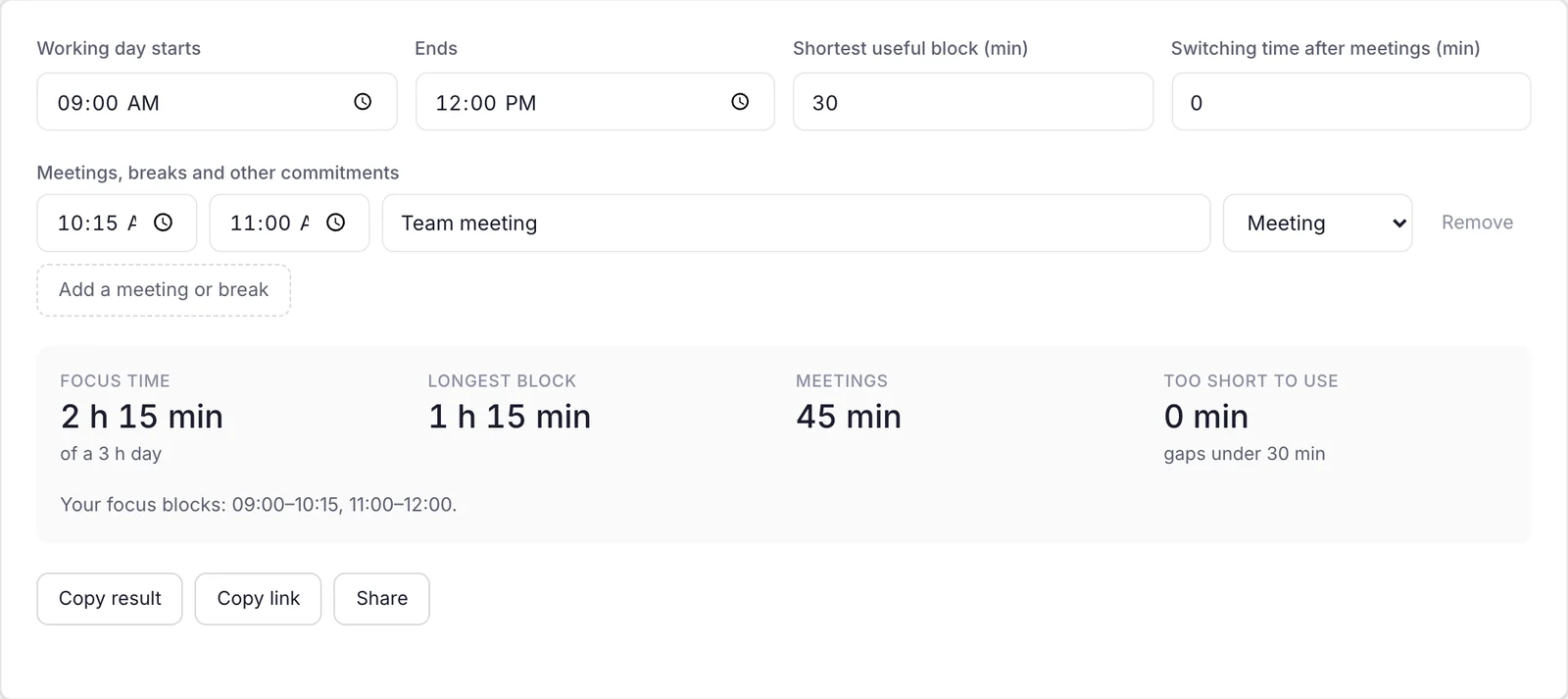
The free Focus Time Calculator does this for a single day: enter your meetings and breaks, and it shows your longest uninterrupted block and how much usable focus time the day really has.
Step 2: Define what a deep-work window is for you
A useful deep-work window is usually at least 90 minutes. That's roughly 15 minutes to get into the task, an hour of real focus, and a margin before the next commitment. If you do very demanding work — writing, code, analysis, design — 2 hours is better.
Also decide when your windows should be. For most people, deep work goes best in the morning. If you're sharper in the afternoon, plan around that instead.
Step 3: Stack your meetings
This is the step that creates time. Wherever you control a meeting, move it next to another meeting:
- Stack meetings back to back in a shared window, ideally with short 5–10 minute gaps.
- Move internal meetings to the afternoon if mornings are your deep-work time.
- Pair meetings with the same people or topic so context switching is lower.
- Put 1:1s together — five 30-minute 1:1s in one afternoon costs less focus than five scattered across the week.
Even moving two or three meetings can turn two broken days into one clear morning.
Step 4: Reserve windows early
Deep-work windows you create are invisible until you claim them. Put the blocks on your calendar at the start of the week — ideally the Friday before — marked busy, and named after the work:
- Deep work: pricing analysis
- Write: chapter 3 draft
Blocks named after real work are respected far more than "Focus" or "Hold". See how to protect focus time on your calendar for keeping them from being booked over.
Step 5: Match tasks to windows
Not every window is the same. Match them:
| Window | Best for |
|---|---|
| 2+ hours, morning | Your hardest task of the week |
| 90 minutes | Substantial work with a clear next step |
| 45–60 minutes | Reviews, editing, planning, preparing a document |
| Under 30 minutes | Replies, admin, quick decisions |
Putting a light task in a 2-hour morning window wastes your best time. Putting your hardest task in a 45-minute gap guarantees it won't get done.
Step 6: Re-plan midweek
Meetings move. Something urgent appears. By Wednesday your carefully arranged week has shifted. Spend five minutes on Wednesday morning asking:
- Did my deep-work windows survive?
- If one was lost, where's the next 90-minute gap?
- Is this week's most important piece of work still on track?
Moving a lost window to Thursday is far better than losing it entirely.
A real example: Chen's ten-meeting week
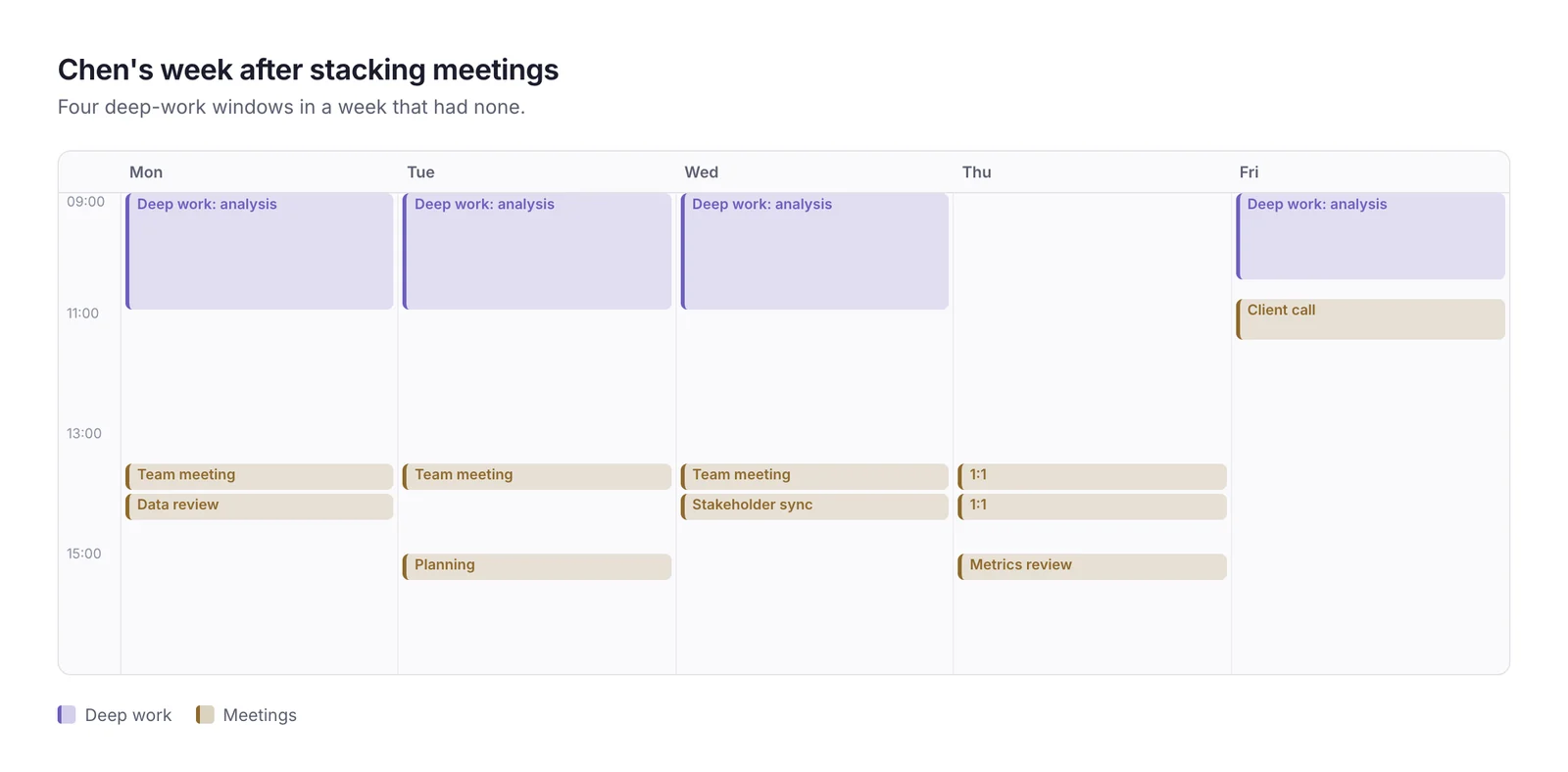
Chen is a data analyst. Her calendar for next week has ten meetings, and a quarterly analysis due Friday that needs about six hours of real concentration.
Before: the meetings were spread across all five days — two a day, one mid-morning and one in the afternoon. Her afternoons went on messages and requests from other teams, so mornings were her only real chance for deep work — and a mid-morning meeting every day left no morning gap longer than 75 minutes. Deep-work windows: zero.
What she changed:
- Asked for the recurring internal meetings on Monday, Tuesday and Wednesday mornings (all at 10:15) to move to 13:30 — all three organizers agreed.
- Moved her own Thursday-morning 1:1 to the afternoon, next to her other 1:1, back to back.
- Left the meetings she didn't control where they were — including a client call on Friday at 10:45.
- Declined one optional review and asked for notes.
After: four deep-work windows — Monday, Tuesday and Wednesday 09:00–11:00, and Friday 09:00–10:30. Seven and a half hours of deep work in a week that had none.
The analysis was finished on Thursday afternoon.
Getting started inside the window
A 90-minute window is only valuable if the first minutes go to the work. A few habits help:
- Decide the task the day before. Open the block knowing exactly what you'll do: draft the methods section, not work on the report.
- Leave yourself a starting point. End each session with a note of the very next step, so the next one begins without warming up.
- Close everything else. Email, chat and notifications off for the length of the block — they'll still be there at 11:00.
When you can't stack meetings
Sometimes meetings are out of your control — customer calls, cross-team rituals, a manager who books whenever. A few tactics still help:
- Protect one morning a week, no matter what. Even one 3-hour block a week makes a difference.
- Use early mornings or late afternoons if they're reliably free.
- Shrink the work. Break a big task into 45-minute pieces with clear goals so smaller gaps can still produce progress.
- Make the case with numbers. "I had no gap longer than an hour last week" is a strong argument for team meeting windows.
Common mistakes
- Treating every free hour as deep-work time. Short gaps are for short tasks.
- Leaving windows unclaimed. If they're not on the calendar, they'll be booked.
- Doing deep work right after intense meetings. Put a short break or light task in between.
- Planning the week and never checking it. A five-minute Wednesday re-plan saves the week.
- Scattering your own meetings. The meetings you organize are the easiest to stack.
Taking it further
- A standing meeting window for your team. "Meetings between 13:00 and 16:00, Tuesday to Thursday" helps everyone.
- A weekly deep-work target. Decide how many hours of deep work a week you need — say, eight — and plan until you reach it.
- Planned versus actual. Compare the deep work you planned with what actually happened, and adjust next week.
Where automation helps
- Automatic time-finding for recurring deep-work goals, placed around your existing meetings
- Focus blocks that defend themselves by declining invitations that land inside them
- Weekly summaries of meeting load versus focus time, so you notice trends
How Daykite helps
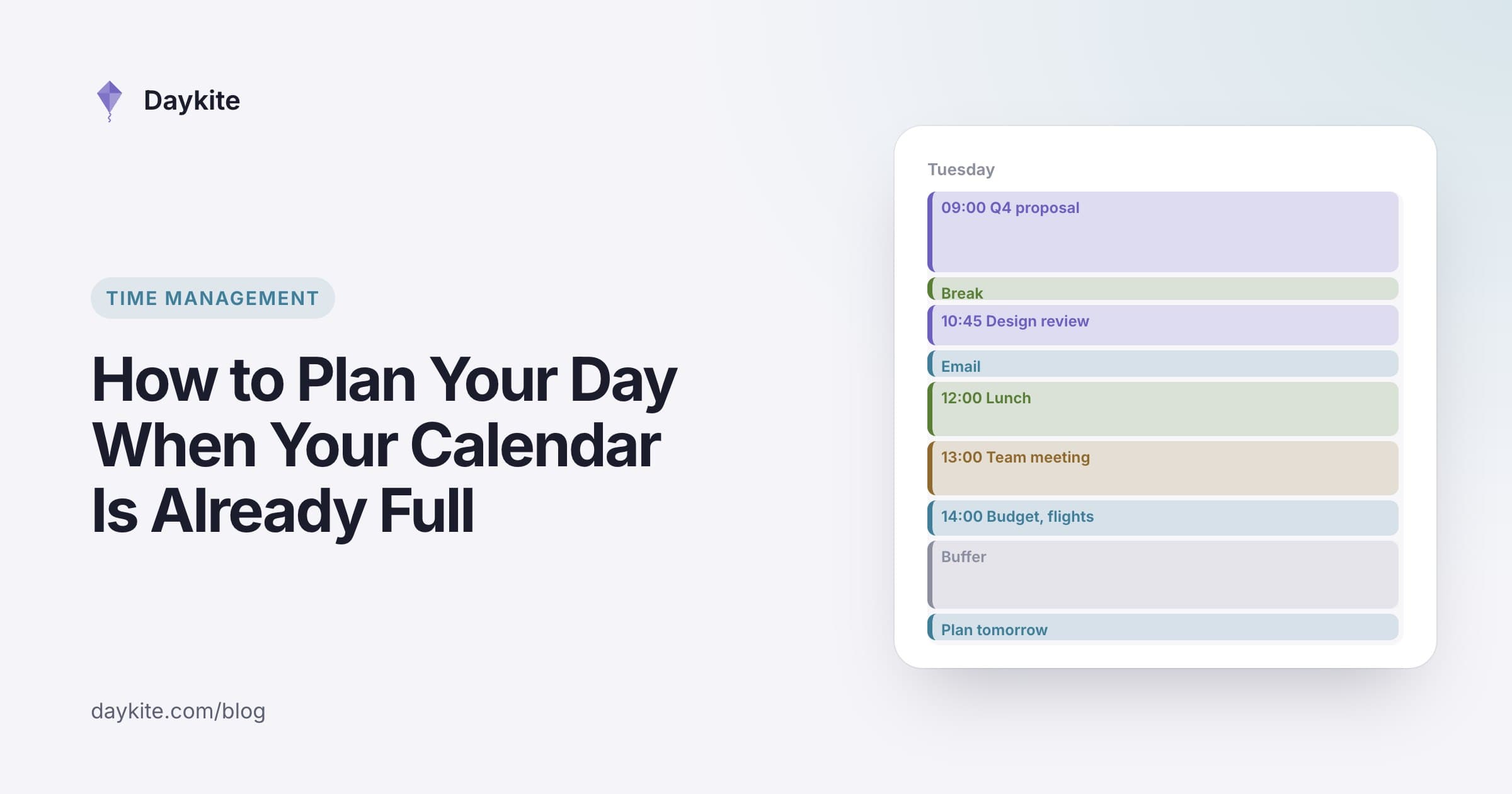
Daykite's Goals let you say Deep work, 8 hours a week, mornings, 90-minute to 2-hour blocks, and Find time places those blocks around your existing meetings, in your best free time, never in protected time — each shown to others as busy. Time Insights shows meeting load and planned focus as a share of your working hours, and flags back-to-back runs. For the day-level version of this problem, see how to plan your day when your calendar is already full.
Frequently asked questions
How long should a deep work session be?
At least 90 minutes for most demanding work, and up to about two and a half hours before a break. Shorter sessions spend too much of their time getting started.
How do I find time for deep work with lots of meetings?
Stack the meetings you control next to each other, move internal meetings to one part of the day, and reserve the longer gaps you create as deep-work blocks early in the week.
Is it better to do deep work in the morning or afternoon?
Most people focus best in the morning, but not everyone. Look at when you did your best work over the last couple of weeks and protect those hours.
How many hours of deep work should I aim for each week?
Start with six to eight hours in three or four blocks. That's enough to move major work forward without making you hard to meet with.
What if my meetings are all scheduled by other people?
Protect one morning a week anyway, use reliably free early or late hours, break big tasks into smaller pieces, and share data about your meeting fragmentation to argue for team meeting windows.
deep workmeetingsfocus timeschedulingproductivity
Comments