How to Build a Morning Routine That Actually Fits Your Schedule
Most morning routines fail because they're built for someone else's life. Work back from your first commitment, time every step, and keep a short version.
The Daykite team7 min read
The internet is full of morning routines. Wake at 5:00, meditate for 30 minutes, journal, cold shower, workout, read, green smoothie. They look wonderful — and almost nobody with a commute, children or a 08:30 meeting can do them.
A morning routine that works isn't the most impressive one. It's the one that fits between the time you wake and the first thing you can't move. This guide shows how to build that, step by step, with realistic examples.
Why most morning routines fail
Morning routines usually break for one of four reasons:
- They're too long. A 90-minute routine collides with real life by Wednesday.
- They start at the wrong time. Waking an hour earlier to "make room" works for three days, then sleep wins.
- There's no backup plan. When the baby wakes at 04:00 or you oversleep, an all-or-nothing routine becomes "nothing".
- They're not on the calendar. An early meeting gets booked at 08:00, and the routine silently loses.
The fix is to design around your real constraints instead of fighting them.
Step 1: Find your fixed point
Start with the first thing in your morning that you can't move: the school run at 08:15, the train at 07:40, the standup at 09:00. That's your fixed point.
Everything in your routine must finish before it — including getting dressed and travel.
Step 2: Work backwards
Subtract the unavoidable time between waking and your fixed point:
- Travel or commute
- Getting ready (shower, dressed)
- Getting others ready (children, pets)
- Breakfast, if it's not part of the routine
What's left is your routine window. For many people it's 30 to 45 minutes, not the two hours influencers suggest. That's fine — 30 good minutes beats 90 imaginary ones.
Step 3: Choose three to five steps
Pick a few things that make the rest of your day better. Good candidates:
- Something for your body — a walk, stretching, a short workout
- Something for your head — reading, journaling, a few quiet minutes without a screen
- Something for your day — reviewing your calendar, choosing the day's most important task
Keep it to five steps at most. Each extra step is another chance for the whole routine to fall apart.
Step 4: Time every step honestly
Give each step a duration, then add them up. Be honest: a "10-minute" shower is often 18. If the total is longer than your window, cut a step or shorten one — don't wake earlier.
Step 5: Put it on your calendar
If your routine isn't visible, someone will book over it. Add it as a recurring block — or at least make sure your working hours don't start before it ends. This matters most if colleagues in other time zones can book early meetings with you.
Step 6: Make a short version for bad days
Every routine needs a minimum version: the two or three steps you'll do even on your worst morning, in ten minutes. For example:
- Glass of water
- Five minutes outside
- Check the day's calendar
On a good day you do the full routine. On a bad day you do the minimum — and the habit survives.
A real example: Amira's weekday mornings
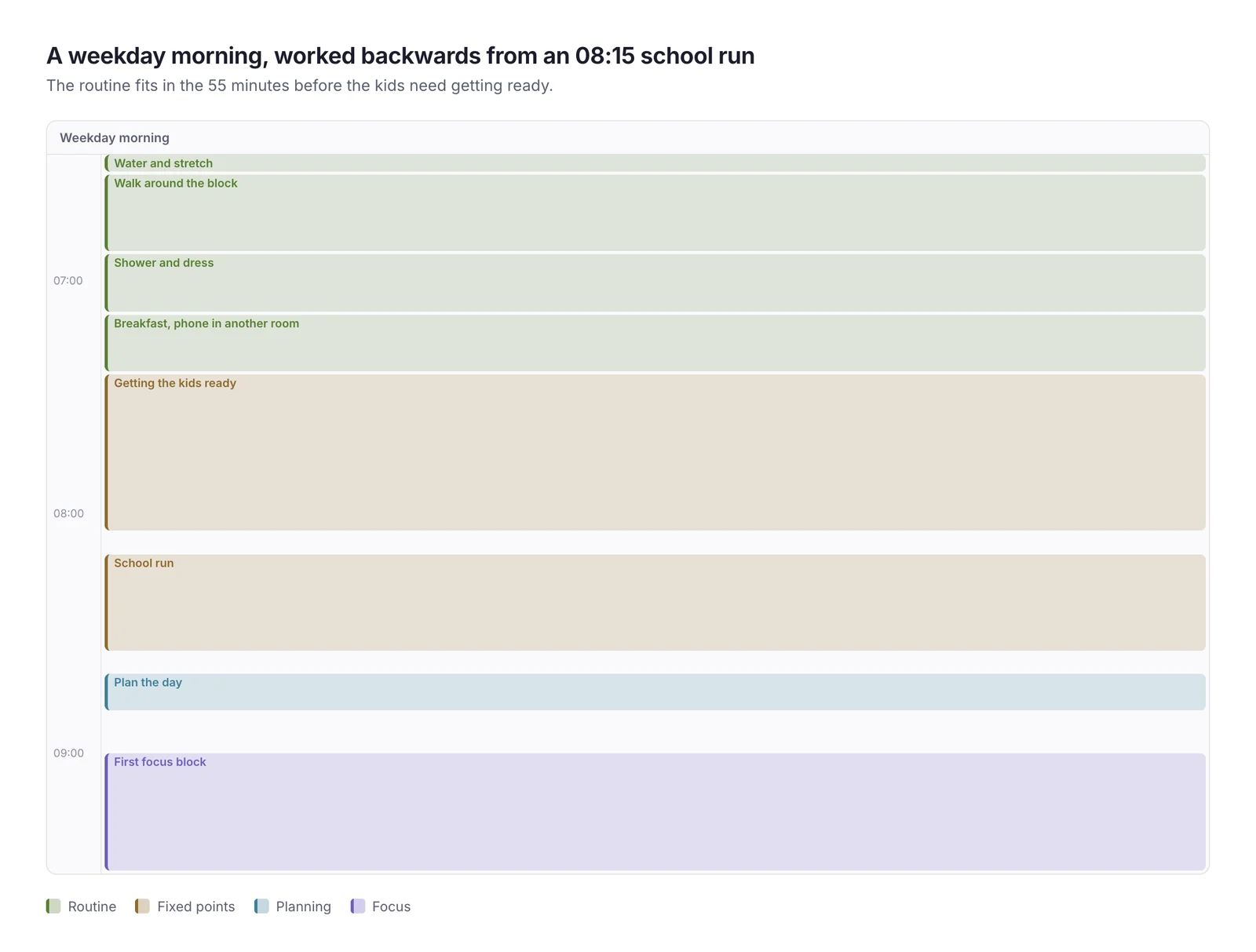
Amira is a product designer with two children. Her fixed point is the 08:15 school run, and she works from home afterwards.
- Wakes at 06:30
- Getting the kids ready takes 40 minutes (07:25–08:05)
- Leaving the house at 08:10
That leaves 06:30 to 07:25 — 55 minutes — for her routine:
| Time | Step | Minutes |
|---|---|---|
| 06:30 | Water and stretch | 5 |
| 06:35 | Walk around the block | 20 |
| 06:55 | Shower and dress | 15 |
| 07:10 | Breakfast, phone in another room | 15 |
After the school run, 08:40–08:50 Plan the day starts her work, and her first focus block begins at 09:00.
Her minimum version: water, ten minutes outside, and look at today's calendar. She uses it about once a week — and hasn't dropped the routine in four months.
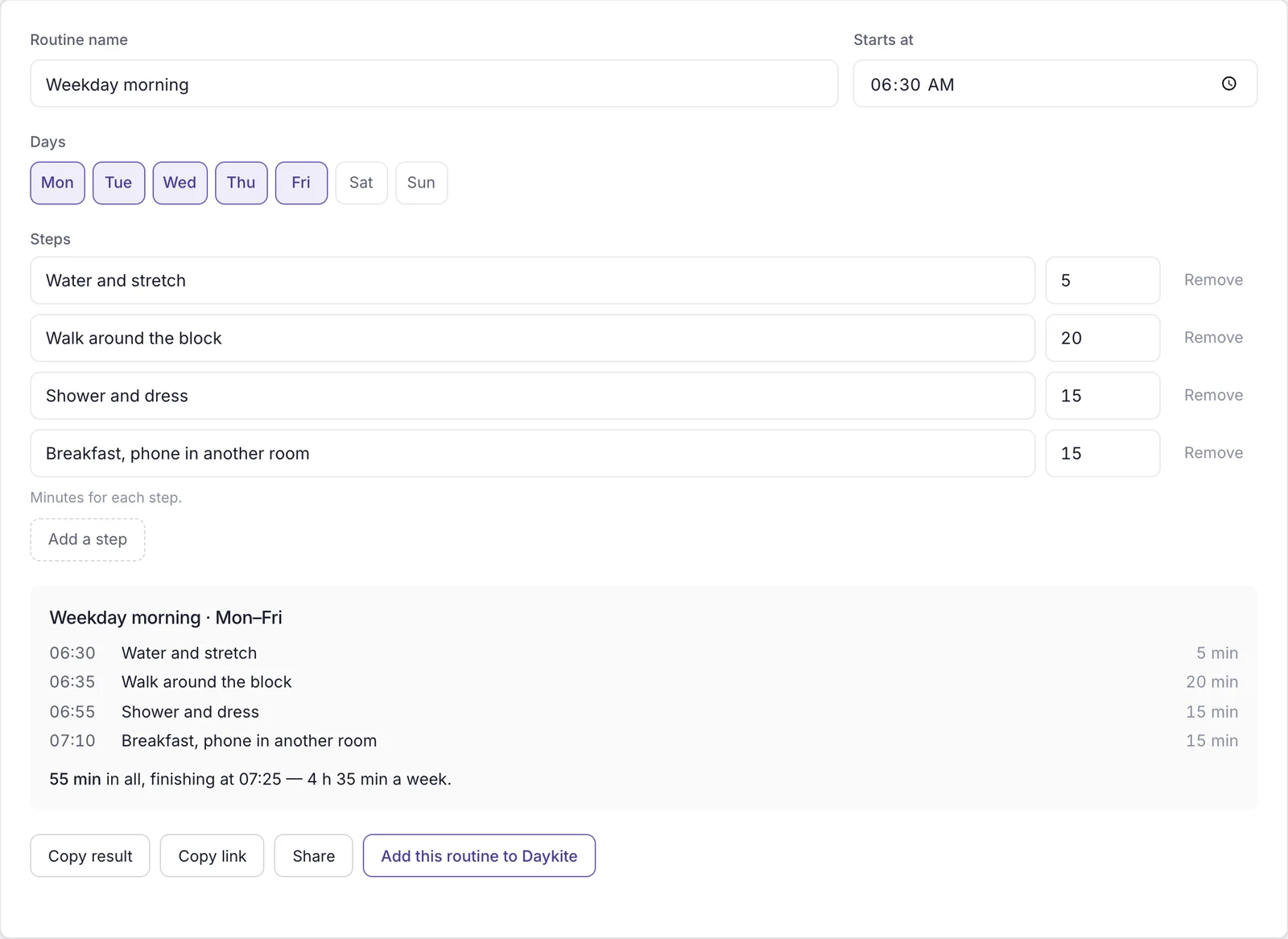
You can build a timed routine like Amira's in the free Routine Builder: add your steps and durations and it shows when each one starts and when you'll finish.
Three more mornings, three different lives
The same method works for very different schedules. Here's how it plays out for three other people:
The commuter. Dan's train leaves at 07:40, and it's a 12-minute walk. Getting ready takes 25 minutes. His routine window is 06:45–07:03 — just 18 minutes. So he keeps it tiny at home (water, stretch, look at the day) and moves the rest onto the train: 20 minutes of reading instead of email. The commute is part of his routine.
The remote worker. Kate has no commute and no children. Her first call is at 09:30. The danger for her isn't too little time — it's drifting straight from bed to laptop. Her routine gives the morning edges: a 25-minute walk that stands in for a commute, breakfast away from her desk, then 15 minutes planning the day before she opens email.
The night-shift nurse. Tomás finishes at 07:00 and sleeps until 15:00. His "morning" routine starts mid-afternoon: water, a short run, a proper meal and 10 minutes with his calendar to see the week's shifts. It follows exactly the same logic — fixed point first (his shift at 19:00), then work backwards.
None of these looks like an influencer's routine. All three are still going months later.
Weekday and weekend versions
Your fixed point is different at the weekend, so your routine can be too. A weekend version might be longer and slower — a proper workout, a long breakfast, time with a book — and start later. Build it separately rather than trying to stretch the weekday one.
Common mistakes
- Copying someone else's routine. Build around your own fixed point.
- Waking earlier to fit more in. Protect sleep first; shrink the routine instead.
- Starting with ten new habits. Add one step at a time, and only once the last one sticks.
- Checking email first. It hands your morning to other people's priorities. Put it after "plan the day".
- All or nothing. Use the minimum version instead of skipping entirely.
Taking it further
- Anchor steps to things you already do. "After I put the kettle on, I stretch" is easier to remember than "at 06:40, stretch".
- Track it lightly. A tick for done, a cross for skipped. After a month, you'll see which steps actually stick.
- Review it monthly. Seasons, jobs and children change. A routine should change with them — your weekly planning routine is a good place to notice when it's time.
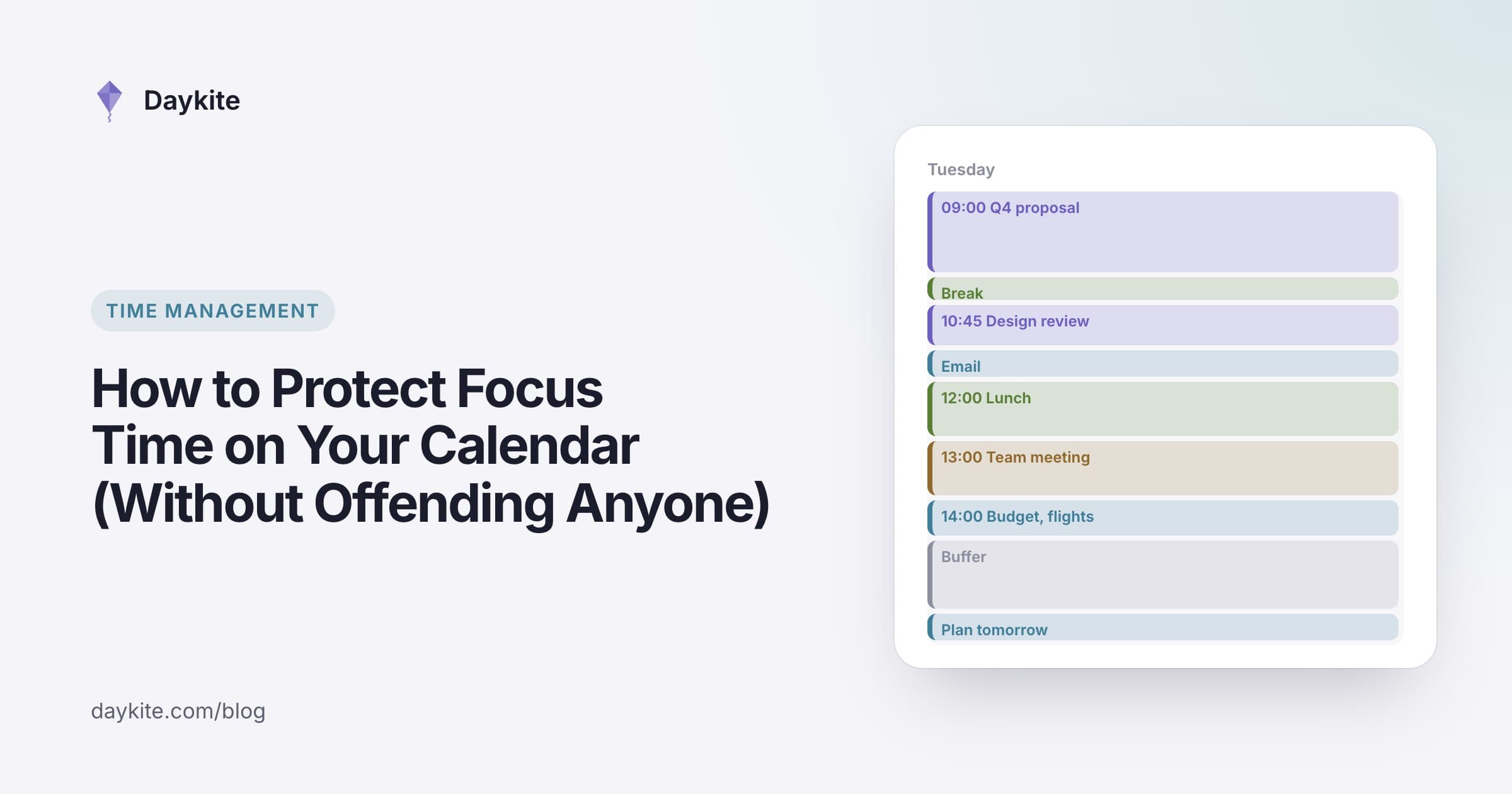
- Protect the first work hour. A good morning routine flows into your first focus block. See how to protect focus time on your calendar.
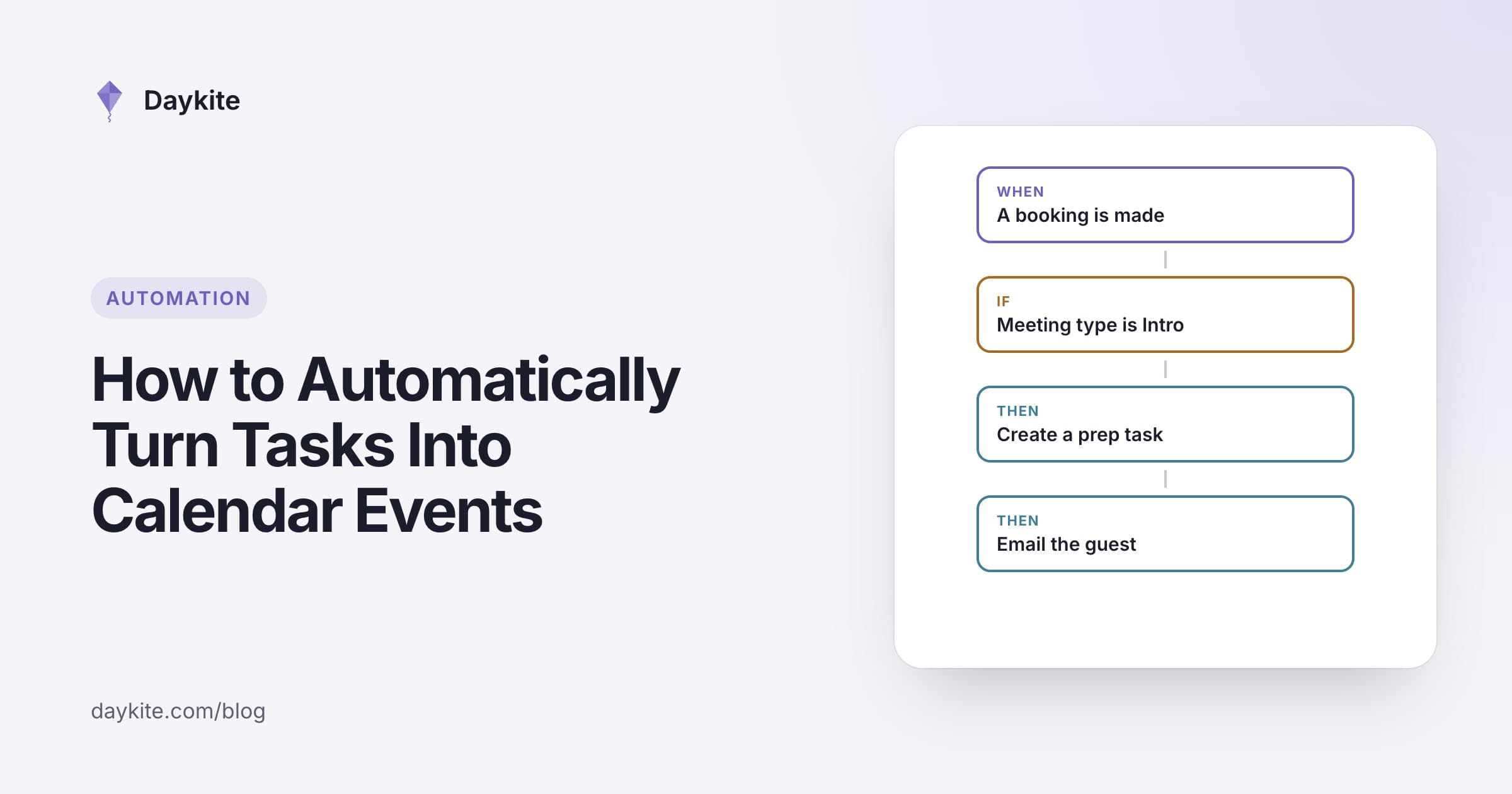
Where automation helps
- A recurring routine that appears every weekday without re-creating it
- Automatic handling of clashes — if an early meeting lands on your routine, suggest a new time for that part rather than silently skipping it
- A small follow-up when you skip — for example, a reminder to fit a walk in at lunch instead
How Daykite helps
In Daykite, routines are the shape you want your days to have, shown beside your calendar rather than cluttering it. You split a routine into periods — Before work, Evening — each with its own tasks, and mark each period done or skipped. When an event lands on a routine period, the assistant's Fix routine clashes suggests a new time for it that day. And because skipping a period can start an automation, "walk skipped" can quietly add a lunchtime walk to your calendar.
Frequently asked questions
How long should a morning routine be?
As long as your mornings allow — often 30 to 45 minutes for people with jobs and families. Build it backwards from your first fixed commitment rather than choosing a length first.
What should a morning routine include?
Three to five steps: something for your body, something for your mind, and something that sets up your day, such as reviewing your calendar and choosing your most important task.
Should I wake up earlier for a morning routine?
Usually not. Losing sleep makes a routine harder to keep. Shrink the routine to fit your current wake-up time first.
What if I miss my morning routine?
Do the minimum version — two or three steps in ten minutes — so the habit continues. Missing one day doesn't matter; missing the routine entirely for a week is how it disappears.
How long does it take for a morning routine to become a habit?
It varies a lot from person to person and habit to habit — often several weeks, sometimes months. Start with one or two steps, keep them small enough to do on a bad day, and add the next only when the first feels automatic.
Should my weekend morning routine be the same?
It can be different. Your weekend fixed points are different, so a longer, slower weekend routine often works better than stretching the weekday one.
morning routinedaily routinehabitsproductivityroutine builder
Comments